The opponent never peeks
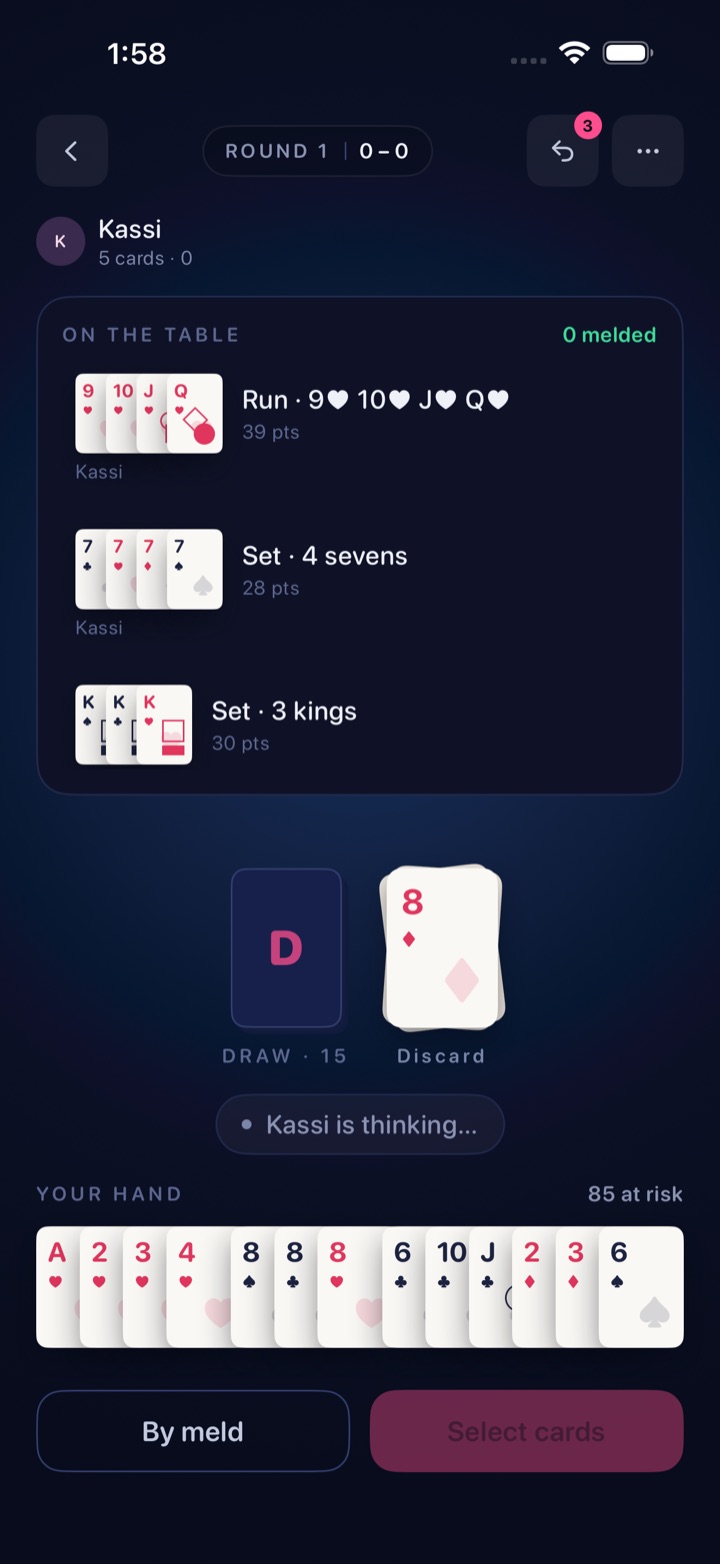
It plays from the same table you can see. It cannot read your hand or the order of the stock at any difficulty — the harder settings just pay closer attention to what has already been played.

Gin Rummy, 500 Rummy, Sequence, Spite and Malice, Deck Dash, War and Go Fish on your iPhone or iPad — against an opponent that plays from the same table you can see and never from your hand.
The catalog
Two rummy games, a board, two races, and the two everybody already knows. Each one opens its rules.
Two hands, ten cards, one knock
Open table, deep pile, long game
Play a card, claim its square, make five
Empty your stock, one card at a time
Race to empty your stock, 1 to 12
Flip. Higher card takes the pile
Ask well, and remember what you asked
What makes it Deckla
It plays from the same table you can see. It cannot read your hand or the order of the stock at any difficulty — the harder settings just pay closer attention to what has already been played.
Casual plays its own hand and little else. Steady remembers the discards. Sharp remembers the discards and reads yours. It is an attention limit, never a hidden advantage.
Signed in, your games and stats follow you between iPhone and iPad. Signed out, everything still works — it just stays on this one device.
Geometric sets flat pips and bold numerals. Typographic sets the rank about three times larger and never asks you to judge a card by the colour of a small pip.
Leave a match at any point and it is waiting on the first screen with the round and the score on it. A save is a deal and a move log, so it comes back exactly as you left it.
The app has no analytics, no advertising identifier and no third-party network calls. Saves, scores and settings live in your own private iCloud database and nowhere else.
The support pages cover getting started, the rules as Deckla implements them, and fixes for the handful of things that go wrong.